

IR-SPECIES-036 · FIELD DOSSIER · S GRADE · SALTWATER · OFFSHORE · UPDATED 2026-10-06
Thunnus albacares
A yellowfin is an oceanic hunter whose location can be a surface feeding patch, a drifting object, an island-associated water mass or a deeper daytime layer. Reading that changing space matters more than assigning the fish one permanent depth.
01 · Identity, scale and the official record
Species passport
English / Chinese
Yellowfin tuna / 黄鳍金枪鱼, also 黄鳍鲔
Names needing care
Ahi can include bigeye; French thon albacore means yellowfin, whereas English albacore is Thunnus alalunga [2] [27]
This passport is useful when a fish has already lost its live colour, when a market label is ambiguous, or when photographs are being used for identification. “Tuna” is a group name. “Ahi” is not a species certificate. The scientific name keeps the dossier, its food photograph and its fishing evidence attached to the same animal.
Biological scale is not a sporting record
FAO’s Western Central Pacific identification guide reports a maximum fork length of 195 cm and common size to 150 cm. Those are values in a particular, older guide, not an eternal biological ceiling. Fork length ends at the tail fork; it cannot be silently compared with a measurement that includes the tail tips. [2]
Longevity needs an even stronger correction. Familiar consumer profiles still describe about six or seven years. Pacicco and colleagues examined 3,443 yellowfin sampled in the U.S. Gulf of Mexico and western Atlantic during 2004–2017 and estimated ages from one to 18 years. Most sampled fish were young; 18 is an observed old individual, not the age of a typical catch. Radiocarbon work independently validates old Atlantic yellowfin. Indian Ocean work supports at least 10.5 years in its examined material. No single short lifespan should be imposed on every ocean. [1] [35] [36] [37]
IGFA record card
Category
IGFA All-Tackle; also men’s 60-kg / 130-lb line class
Weight
200.94 kg / 443 lb
Angler
Earl Gill IV
Capture date
11 November 2024
Place
Lower Banks off Mexico
Vessel / captain
Excel / Justin Fleck
Method disclosed
Cut bait; 1 hour 45 minutes to land
Official announcement
IGFA, 15 April 2025
Length, exact hook, leader and knot
Not disclosed in this announcement
IGFA explicitly approved this catch, exceeding the preceding mark by 16 lb, and repeated the approval in its January 2026 recap. It is the latest approved record located in the primary material reviewed here. A weighed, documented sporting record answers a different question from a species-guide size summary. [3] [51]


02 · Identify the body, including the fish that has not grown its sickles yet
Four field anchors
First, look for the streamlined body tapering strongly into a narrow tail base and a deeply forked tail. Second, locate the two dorsal fins close together. Third, examine the second dorsal and anal fins as a pair: in a large yellowfin, both can develop striking backward-swept, yellow sickles. Fourth, inspect the separate finlets behind those fins and the moderately long pectoral fin. The pectoral is not an albacore’s exceptionally long wing. [2] [32]
Adult anatomy must not be pasted onto a juvenile. A small yellowfin has relatively modest second dorsal and anal fins; absence of long sickles does not exclude the species. Museum-vouchered juvenile photographs are consequently as important as a spectacular adult portrait. In large specimens, the median fins can exceed one-fifth of fork length in height. That is a size-related identification feature, not a promise that every fish will carry equally long streamers. [32] [34]
Metallic blue or green upper colour, a lighter silver belly, yellow fins and dark-edged yellow finlets help confirm the overall pattern. They should support structure rather than replace it. A dead or chilled specimen can look very different from a brightly lit swimming fish. Photo references must preserve that distinction; fading should not be “corrected” into a new, unsupported pattern.
The difficult comparison: yellowfin and bigeye
Bigeye and yellowfin can share schools and look frustratingly similar when small. Long adult sickles favour yellowfin, but a juvenile diagnosis needs the official identification guide’s combination of body markings, fin form and proportions. Yellow finlets alone do not settle it: bigeye also has yellow finlets. Albacore offers an easier contrast because its pectorals extend much farther rearward. Never turn a partial photograph into a confident species identification merely because it has yellow somewhere on it. [2] [33]
Physiology that changes the practical question
Yellowfin has slender, conical teeth. That does not make its terminal tackle immune to wear. It also does not justify borrowing a wire bite trace from a different predator. [32]
Stanford’s research team examined yellowfin and Pacific bluefin and found hydraulic control in their dorsal and anal median fins: muscle, fluid channels and fin supports work together to adjust fin position and shape. The sickles are functional control surfaces. Their precise developmental explanation remains separate from demonstrating how they move. [19]
High-performance swimming and oxygen supply
Plan handling before capture; keep release photography brief and the fish wet. This is handling practice, not a measured yellowfin air-exposure allowance [22] [42]
Heat retention and high metabolic demand
A warm-bodied tuna still responds to water temperature; do not treat endothermy as unlimited access to cold depths [31] [5]
Adult fins versus juvenile fins
Use age/size-appropriate visual references; do not reject a young yellowfin for lacking adult sickles [32] [34]
A tuna circling beneath the boat
Follow the loaded line around the boat and protect it from hull contact; morphology alone does not provide a safe drag setting [18] [38]

03 · Habitat atlas: an ocean is a layered landscape
The geographic frame
Yellowfin occupies warm oceanic water across three great ocean basins. Its habitat is not synonymous with a coral reef. A reef island, an atoll, a shelf edge or an offshore bank can help locate a fishing region, but the tuna itself may be in the water column above or far outside that landform. Larvae and juveniles tend to occupy upper water; larger fish can use a wider vertical space. Floating objects and anchored aggregation devices are recurring association points. [1] [32]
The atlas therefore uses a high-aerial global index and separately numbered regional scenes. Its arrows show explanatory movement or association, not exact reconstructed tag tracks. The region count follows distinct evidence, rather than a decorative template.
1. Eastern tropical Pacific: oceanic schools, floating-object context and the documented tuna–dolphin relationship. The important space is open pelagic water and its upper thermal structure, not an invented reef canyon. [9] [12] 2. Main Hawaiian Islands: adults tagged off Kauaʻi demonstrate both island association and dispersal offshore. Residence near an island and movement into the open North Pacific can both be real. [6] 3. Northwest Atlantic: warm-water edges and seasonal offshore opportunities, with a dated jigging case south of Martha’s Vineyard. A shelf margin is geographic context; the lure is placed in a feeding layer. [10] [11] 4. Gulf of Mexico: a day/night comparison grounded in a small archival-tag study, with warmer mixed-layer use and deeper daytime movement. [5] 5. Maldives: the atoll chain provides a geographic frame for small yellowfin, drifting-object associations and monsoon-linked regional fishery changes. The fish are not being depicted as lagoon or coral-nursery residents. [8] 6. Seychelles: an adult captured near an anchored FAD and its unusual deep excursions, carefully separated from its ordinary upper-water occupancy. The capture location does not establish continuing FAD association or residence. [7]
Relative Z-axis: three useful layers, no invented universal ceiling
Surface and upper mixed layer
What supports yellowfin use: Young fish, visible feeding and floating-object associations; surface lure cases [1] [12]
What the observer should establish: Are tuna actually feeding here, or are only birds and other fish visible?
Mixed-layer base / thermocline transition
What supports yellowfin use: Tagged Gulf fish and regional jigging opportunities [5] [11]
What the observer should establish: Where are the current temperature transition and prey marks? Neither is a fixed depth everywhere
Deeper excursions beneath the usual upper habitat
What supports yellowfin use: Adult telemetry in Hawaii and the Seychelles [6] [7]
What the observer should establish: Is this a brief dive, a regional daytime pattern or a sustained feeding layer? A maximum dive is not a fishing target
In the Hawaiian adult study, pooled median daytime depth was 103 m and nighttime depth 34 m, but individual habitat varied. Those are summaries of tagged adults in that study, not instructions to deploy a lure at 103 m every afternoon. The exceptional descent to 1,592 m was associated with a possible predator-escape event. It belongs in the account of capability, not a diagram of routine feeding. [6]
The Gulf study followed six fish and found a shallower nighttime/deeper daytime pattern; they generally avoided water more than 6°C colder than the surface. This is a sample-specific thermal relationship, not a global lethal limit. The Seychelles observation involved one 134-cm fish: its extraordinary dives do not erase its strong upper-water use. [5] [7]
Stages and seasons
The early life of a tuna occurs in a pelagic environment, without the familiar transition from estuarine nursery to adult reef. IATTC’s Achotines work follows eggs, plankton-feeding larvae and early juveniles in controlled rearing. Nearly daily spawning over long periods in captive broodstock illustrates reproductive capacity; it does not quantify survival of wild larvae. [21] [41]
Historical Maldives research distinguished small surface-swimming fish from larger yellowfin taken by different gears. It described juvenile movements matching east–west monsoon changes, while noting that evidence did not establish a net northward migration in that tagging material. Regional seasonality should retain its place, date and life stage. An old catch pattern is not a booking calendar for 2026. [8]

04 · Prey, association and the signals that survive a reality check
A flexible predator, not a universal sand-eel specialist
Stomach research in the eastern Arabian Sea examined 406 yellowfin spanning 48–165.5 cm fork length. Flying squid dominated the diet there, alongside swimming crabs, cigarfish and flyingfishes. This is a particularly useful correction to a lure catalogue that would make every yellowfin an anchovy or sardine specialist. [20]
The offshore New England jigging demonstration instead reported fish feeding on sand eels. That observation explains why a slender, sinking presentation made sense in that trip’s water column. It does not establish the diet of yellowfin off Hawaii or the Maldives. A useful lure choice begins with the local prey layer and fish response, not the species name alone. [11]
Association is another clue with an important limit. A drifting object, FAD or dolphin pod is a place to investigate, not a guarantee of a catch. Scientists can record an association without proving its exact cause. Food, orientation, social behaviour and other explanations should not be collapsed into one story whenever a tuna swims beside an object. [1] [43]
Far / Mid / Close reading matrix
Far: ocean and boat approach
Observable signal: Tuna breaking, birds working prey, a moving pod, warm-water edge
Bounded interpretation: A search lead; wildlife activity alone is not species identification
Immediate decision: Let the captain position ahead of moving fish, respect boats already set up, and prepare a long cast [39]
Mid: feeding patch and sounder
Observable signal: Surface feed or a marked subsurface prey/fish layer
Bounded interpretation: Decide which layer is presently available to a lure
Immediate decision: Use surface presentation for actual surface action; use the dated regional jigging route when fish hold deeper [11] [12]
Close: lure and line
Observable signal: A visible blow-up, then line loading; or unexpected slack during a fight
Bounded interpretation: Splash alone may precede secure load; slack may mean a fish approaching the boat
Immediate decision: Follow the source’s hookset protocol; reel promptly to regain contact when fish changes direction [18] [38]
A feeding ball and a moving school call for different placement. Capt. Jim Freda describes casting into a contained feed, but getting ahead of a travelling pod and bringing the lure away from it. These are situational captain observations. They are more precise than a blanket command that every cast must land outside every school. [39]
Two-stage popper protocol
Stage one is visual contact. A splash confirms an attack near the lure, not necessarily a securely loaded line. Ryan Morie’s yellowfin-led account warns against striking immediately at the sight of a blow-up. A fish may be coming toward the boat.
Stage two is mechanical commitment. In his procedure, wait until the fish’s weight loads the line and begins pulling drag before setting the hook; stay ready to wind if the line becomes slack. This is a traceable operating protocol for his popping practice, not a claim that every yellowfin bite follows one biological sequence. It must not be transferred to an undisclosed hook system or to circle-hook bait fishing. [38]

05 · Lure-first routes, real rig nodes and failure control
Five routes to choose by the fish, the boat and the presentation
Surface casting, a hooked metal jig and a freely swimming live fish offer three different ways to reach yellowfin. Sagami Bay adds two well documented regional systems: EBING and krill komase. The latter uses a chum basket, which releases feed in the water column; it is not a shrimp trap or a requirement to fish on the seabed. None of these five routes is a whole-species default. Choose from the observed feeding layer, the vessel's working arrangement and the bait or lure actually available. [10] [11] [12] [13] [17] [46] [47] [48] [52] [53] [63] [65]
Surface casting
When the evidence supports choosing it: Yellowfin are feeding at the surface or a boat can present ahead of a moving pod
Physical presentation: Popper or stickbait cast across the upper water; the worked example below is a Mikros-Pop 170
Geographic and operational boundary: Named Northeast/Mid-Atlantic captains; each author's retrieve and hardware remain separately attributed. [10] [17] [38] [39] [62]
Ordinary or electric metal jig
When the evidence supports choosing it: A vessel locates fish or prey below the surface and can work a jig through that layer
Physical presentation: Hooked metal jig lowered and retrieved vertically; the Miyako source layout is a separate electric-jigging example
Geographic and operational boundary: Actual The Dump, Panama and Miyako cases; no universal seabed rule, fish depth or hookset timing. [11] [13] [63]
Live-sardine free-line
When the evidence supports choosing it: Live sardines and the boat's live-bait operating system are available
Physical presentation: One live sardine swims on a single hook while line is fed freely
Geographic and operational boundary: Chōzaburōmaru's Sagami Bay arrangement, reported in the 2020 issue and published online in 2021; current availability requires the boat's confirmation. [65] [66]
Regional Sagami EBING
When the evidence supports choosing it: The named party-boat practice and captain-directed subsurface layer apply
Physical presentation: A hookless jig attracts; a separate hooked soft worm trails from the straight arm
Geographic and operational boundary: Sagami Bay's position, alignment and retrieve sequence; keep Honda's diagram distinct from Kuriyama's outfit. [46] [47] [48]
Regional Sagami krill chum basket
When the evidence supports choosing it: The vessel is operating the documented komase fishery in a permitted area
Physical presentation: Weighted chum basket on one tenbin branch, long krill-baited hooklength on another
Geographic and operational boundary: Sagami Bay practice, current basket order and regional agreement; a captain's layer call is not a global yellowfin depth. [52] [53] [54] [55] [56] [57] [58] [59] [61]
The older water-layer table below also retains an independently documented diving-minnow trolling option. Its manufacturer's presentation guidance does not override local restrictions, including Kanagawa's recreational-trolling prohibition. [14] [58]
Choose the water layer before the hardware
Yellowfin qualifies for a mature, traceable offshore lure-fishing profile because manufacturer demonstrations and first-person captains document surface plugs, vertical jigs and trolling lures. The record fish’s cut bait is a documented individual method, not the basis for that broader profile. Different routes below remain separate rather than being blended into an imaginary universal tuna outfit.
Surface popper
Supported scenario: Northeast/Mid-Atlantic captain practice; Costa Rica manufacturer demonstration
Presentation layer and path: Cast to present surface feeding; sweeping pops/chugs across the upper water [10] [12]
Reset or limitation: Bird-hooking risk, poor approach or absent surface response require reassessment
Vertical jig
Supported scenario: The Dump, south of Martha’s Vineyard, 10 August 2023; Panama firsthand account
Presentation layer and path: Drop to the observed fish/prey layer, then work upward with source-specific lifts and retrieve [11] [13]
Reset or limitation: A bottom-contact instruction from a reef case must not become a pelagic bottom-fishing rule
Trolled diving minnow
Supported scenario: Nomad’s explicitly yellowfin-suitable DTX 200 HD guidance
Presentation layer and path: Moving horizontal search with a product-defined diving path [14]
Reset or limitation: Claimed depth depends on speed and deployment; do not infer fish depth from the lure brochure
Japanese EBING
Supported scenario: Honda/Yamaria yellowfin rigs and named Sagami Bay practitioner
Presentation layer and path: A jig-weight branch and a separate trailing hooked worm, worked through the captain-directed subsurface layer [46] [47] [48]
Reset or limitation: Keep the two branches distinct; deployment and alignment prevent a tangled hooklength
Surface casting: Mikros-Pop 170
DeGennaro’s August 2026 account names a 50–65-lb braided main line, FG connection, 80-lb fluorocarbon leader of 8–10 ft, clinch knot to a SPRO size-5 ball-bearing swivel, SPRO size-7 Power Split Ring, and factory-rigged Boomer 180 or Mikros-Pop 130/170. His preferred reel is Stella SW 14000XG; Pelagic Sniper 150/200 rods are named. Factory hook number and working drag are not specified. [17]
Text topology: braid → FG → fluorocarbon leader → clinch → swivel → split ring → lure tow eye → factory lure body/hook hardware.
The swivel and split ring are different nodes. The knot does not terminate on an imagined extra solid ring. Lure-size names are retained as product names unless the manufacturer independently states physical units. A rod’s maximum drag rating is not permission to set that drag in this assembled rig.
Main line and connection
Disclosed specification: 50–65-lb braid; FG
Function / unresolved field: Running line and leader joint
Leader
Disclosed specification: 80-lb fluorocarbon; 8–10 ft
Function / unresolved field: Abrasion/contact segment
Terminal
Disclosed specification: Clinch; SPRO BB swivel #5; Power Split Ring #7
Function / unresolved field: Connects to lure tow eye; component load ratings not stated here
Lure / hook / weight
Disclosed specification: Boomer 180 or Mikros-Pop 130/170, factory-rigged
Function / unresolved field: Hook number and total mass not stated in this source
Working drag
Disclosed specification: Not disclosed
Function / unresolved field: Must not be invented from reel or rod maximums
Standing position and delivery are separately documented by Awe: secure the feet on deck, cast, close the bail, retrieve slack and begin rod sweeps; keep the loaded line away from the hull. That is a compatible regional operating account, not proof that he used DeGennaro’s exact terminal chain. [10]
Morie varies the retrieve with fish activity: a 3–5-second pause between pops in quieter conditions, or a faster sequence during active feeding. His short pause is not a mandatory cadence for every sea state, popper or school. [38]
For the physical example, select Mikros-Pop 170: the maker states 170 mm, 87 g, two 7/0 inline single hooks and size-5 factory hook rings. Those are the rings at the hook attachments. DeGennaro's separate SPRO size-7 Power Split Ring at the lure nose and size-5 ball-bearing swivel remain the terminal connection from his account. A numeral attached to a hook ring, a nose ring or a swivel identifies a different component; it does not make them interchangeable. [17] [62] [70]
DeGennaro places his named Pelagic Sniper 150/200 rods within an 8–8.5-ft range; no more precise individual length is assigned here. His PE 4–6 description varies with braid brand and does not establish a fixed conversion from the stated 50–65-lb mainline. The maker's 87-g figure describes the lure specification, rather than a measured total for the complete line, swivel and nose-ring assembly. [17] [62]
This extends the published chain with independently verified factory hardware: 50–65-lb braid → FG → 80-lb Yo-Zuri HD Carbon, 8–10 ft → clinch → SPRO ball-bearing swivel #5 → SPRO Power Split Ring #7 → Mikros-Pop 170 nose eye → lure body with its two separate inline-single hook attachments. The original manufacturer photograph visibly shows both singles, their attachment rings, the nose split ring, a ball-bearing-style swivel and leader. It does not identify the pictured lure as the 170 rather than the 130, or prove it is DeGennaro's photographed outfit; the selected 170's measurements come from the maker's specification. [17] [62]
Two alternatives stay separate. Mikros-Pop 130 is 130 mm/40 g, with 3/0 singles and size-4 factory hook rings. Boomer 180 is another source-17 option; its maker describes a BKK Raptor Z belly treble and Suteki Crafter tail hook. Neither hook arrangement belongs on the selected Mikros 170 drawing. [17] [62] [72]
DeGennaro later uses looser “snap swivel” wording, while his specific hardware recommendation names the ball-bearing swivel and separate split ring. The exact SPRO swivel subtype and its load rating are unresolved. The current two-welded-ring SPRO product photograph is a component comparison, not proof that he used that precise variant. An additional snap, Coastlock or solid ring is therefore not supplied as part of his chain. [17] [71]
Work the surface presentation in the following order, keeping each operating account's scope clear:
1. Stand and approach. Establish a secure stance on the working deck and a clear casting lane. Awe documents secure footing and keeping the loaded line clear of the hull; Freda distinguishes casting into a contained feeding group from leading a moving pod. Their accounts do not prescribe one deck side or prove that their boats used DeGennaro's exact terminal outfit. [10] [39] 2. Deliver and establish contact. Cast to the selected presentation point, close the bail, recover loose line and begin controlled rod sweeps. The sequence comes from Awe's regional yellowfin practice. [10] 3. Make the selected lure work. The Mikros maker describes straightforward pops with a 1–2-second recovery pause. It also describes a medium-to-fast, tip-down retrieve for a subsurface action and tip-up skipping. These are product options, not an instruction to combine every action into one cast. Morie's separately documented 3–5-second quieter-condition pause is a different, activity-dependent routine. [38] [62] 4. Read the bite before setting. A surface explosion is a visual cue to stay ready. In Morie's protocol, wait for the fish's weight to load the line or draw drag, then set. Do not turn the visible splash itself into the hookset cue. [38] 5. Retrieve under load. Be ready to wind when a fish changes direction and slack appears. Maintain contact and keep the line away from the hull while the crew prepares the landing. Working drag, boat speed and a universal fighting-rod angle remain unspecified for this assembled example. [10] [17] [38]
Daiwa's general offshore-casting lesson principally teaches bonito and mahi-mahi while listing yellowfin and small yellowfin as possible catches. Its complete approximate outfit can support structural comparison; its lighter line ratings, mahi-mahi association with floating structure, fighting angle and drag fraction do not replace this regional yellowfin chain or become universal yellowfin instructions. [67]

Open full-size surface casting: boat station, popping and recovery

Open full-size surface casting: mikros-pop170 complete source-bounded chain
Metal jigging: Daiwa's Miyako source layout
Daiwa's Miyako Island demonstration is explicitly about yellowfin jigging and also contains albacore. Its target diagram labels Neostage DG, SEABORG G300J, PE gō 5, nylon gō 30 and Electric GAME KY 250 g; the adjacent target text identifies the Neostage DG 60B-4 rod. Keep this outfit distinct from Daiwa's broader diagram using G300/G400, PE 3–5, fluorocarbon 12–30 and 220–350-g jigs. Nylon is not silently replaced by fluorocarbon. [63]
Rod and reel
What the target source identifies: Neostage DG 60B-4; SEABORG G300J
What remains unknown: Working drag and target mainline length
Mainline to leader
What the target source identifies: PE gō 5; nylon gō 30
What remains unknown: Joint name, tying passes and leader length
Jig
What the target source identifies: Electric GAME KY, 250 g
What remains unknown: A fixed fishing depth cannot be derived from jig mass
Front hook
What the target source identifies: One source-drawn hook at the jig's front end
What remains unknown: Hook model, size, cord, eye or spade form and detailed junction
The accompanying figure follows this source layout, including its one drawn front hook and a neutral marker where the hook junction is unspecified. It shows the documented rod, reel, lines and jig; it is not a complete assembly recipe. The source does not reveal enough to prescribe the joint, terminal knot or assist attachment. [63]
Current manufacturer information supplies separate component corroboration: the KY 250 model is 250 mm/250 g, sold hookless, and lists a D-Swivel SS rolling swivel #3 and included split ring #7. The photographed factory front path is rolling swivel → split ring → jig tow eye. No additional solid ring is established. Its generic terminal photograph shows two front assists and an unconfirmed other-species fish; it does not prove a two-hook Miyako yellowfin system. The product's suggested hook-size table includes albacore and other fish, but excludes yellowfin. Current component information also does not prove that every accessory in the historical demonstration was identical to today's product. [63] [64]
The original Miyako video supports a limited operating sequence:
1. Take the rail position. The practitioners stand at the rail and operate hand-held rods over open water. The exact side, a fixed rod angle and boat manoeuvre are unreported. [63] 2. Work the metal jig. Daiwa describes high-speed electric retrieval, one-pitch jerking and manual retrieval as available modes. Match the actual lowering layer and jig choice to the vessel's instructions, depth and current; the selected 250-g jig is the source example, not a universal weight or depth rule. [63] 3. Observe and retain the useful setting. Hands on the electric controls and subsequent loaded-rod phases are visible. A caption explains the ability to reproduce the hit layer and speed. This is an attributed feature of the method; no numerical speed or fish depth is supplied here. [63] 4. Fight with the loaded rod and reel. The footage shows controlled loaded-rod handling and a late yellowfin catch. It does not establish the exact first-bite cue or hookset timing, so those details require the vessel's guidance and the actual hook system. The surface-popper and krill-komase set protocols are not substituted. [63]
The Dump and Panama accounts below provide independently documented conventional jigging examples. Daiwa's general Seriola lesson can help explain rod, reel and jig motion, but cannot supply yellowfin-specific hook sizes, strength ratings or a seabed-residency rule. [11] [13] [68]

Open full-size miyako metal jigging: rail position and controlled recovery

Open full-size miyako metal jigging: limited source layout
Live-sardine free-line: Chōzaburōmaru
Tsuri Joho's original Chōzaburōmaru report describes a Sagami Bay yellowfin system built around a live sardine swimming with little terminal burden. The print issue is dated 1 September 2020 and the web article 7 September 2021. Its boat arrangement and operating numbers describe that documented fishery; access in 2026 does not establish current bait availability or an unchanged sailing routine. [65]
Rod
Source-specific configuration: Diagram: 6–7 ft, PE 4–6 class, maximum jig rating 200 g
Connection or limit: This rod rating is not a bait or sinker weight
Spinning reel and running line
Source-specific configuration: Capacity for PE gō 5–6, at least 300 m; source recommends a reel with maximum drag capability of at least 15 kg
Connection or limit: Maximum capability is not the fishing drag setting
Leader
Source-specific configuration: Fluorocarbon gō 16, 1.5–2 m
Connection or limit: Direct mainline connection; no swivel
Mainline joint
Source-specific configuration: Diagram names densha-musubi or PR; captain recommends densha-musubi
Connection or limit: No tying-turn count is provided; FG/PR are separately acknowledged alternatives
Hook
Source-specific configuration: Captain's choice: Owner Cut Hiramasa gō 13
Connection or limit: One eyeless spade hook, with the shank-bound connection shown in the report
Bait
Source-specific configuration: One live Ma-iwashi sardine, nose-hooked
Connection or limit: Anchovy gill-hooking and large-sardine back-hooking are distinct alternatives
The continuous chain is spinning reel → PE 5–6 → direct joining knot → 1.5–2 m of fluorocarbon 16 → shank-binding knot → one Cut Hiramasa 13 → nose-hooked live sardine. The source explicitly excludes a swivel to reduce burden on the bait. It supplies no sinker, float, basket, extra shock leader, stinger or second hook. The rod diagram's PE 4–6 class and 200-g maximum jig rating remain separate from the actual PE 5–6 mainline and live bait. [65]
Owner's official product page, size silhouettes and gō-13 package confirm Cut Hiramasa, product 10413/90413, JAN 4953873148941, with a spade-style top rather than an eye. The report allows an external shank-binding knot or a Nampō longline knot, and its real hook photograph shows a shank-bound attachment. The named knots do not authorize invented wraps or line passes. The bait-mounting diagram places the selected sardine hook through the nose; it separately illustrates anchovy gill-hooking and a large vigorous sardine's back-hook option. Those alternatives are not superimposed on the default sardine. [65] [66]
The complete operator sequence is specific to this boat:
1. Use the assigned position. The report places spinning free-line anglers along starboard and at the port stern. Port bow is the separate pole-fishing/live-chumming crew zone. The captain approaches according to the feeding group's direction; crew release live fish and call the start. This allocation does not prescribe the layout of every charter boat. [65] 2. Hook and release gently. Open the bail and keep the rod low while attaching the bait. Promptly make a gentle release into the sea. Avoid leaving the fish hanging or substituting a forceful lure cast for the reported handling. [65] 3. Let the sardine swim. Hold the rod along the outgoing line and touch the spool rim lightly as line leaves with the bait's swimming. The report treats 20–30 m of outgoing line as a feed/reset window: if the bait fails to draw a bite and keeps going beyond about 30 m, recover it and replace it with a vigorous fish. This is not a measured yellowfin depth or a universal casting distance. Weak, surface-swimming or returning bait also prompts replacement in the account. [65] 4. Read the run, then establish load. The gradual outgoing line suddenly slips out fast when a tuna takes. Allow that run; when it eases, close the bail, let tension build and raise the rod to set. This is the source's sequence, rather than an immediate set at the first movement. [65] 5. Fight and retrieve with the crew. The report starts around 2 kg of drag, then increases pressure gradually after the run stops and the fish weakens. That historical operating figure is distinct from the reel's maximum capability. Pump rather than trying to haul the fish solely by winding the handle. As the fish circles, hold with the rod when it turns outward and gain line when it turns boatward, then guide it to the crew's landing net. [65]
This live-fish free-line route is an additional natural-bait teaching system. Daiwa's XFG material also lists yellowfin among targets for shore-current presentations using live, dead or cut bait, but that shore system is a separate context. It does not add floats or terminal hardware to Chōzaburōmaru's boat assembly. [65] [69]

Open full-size live sardine free-line: rail station, feed-out and bite

Open full-size live sardine free-line: complete source-bounded physical rig
Jigging is a branching load path
Peña’s Panama-linked account describes the leader tied to the solid ring, with assist-hook cord connected there; a split ring carries the jig. Under fish load, the hook path and the jig’s own hanging branch are distinct. It is mechanically different from a popper with hooks attached to its body. His conventional outfit used 65–80-lb braid, six feet of 100-lb leader and 6–9-oz jigs, but the braid-to-leader knot was not disclosed. [13]
Hogy’s separate 2023 case lists a tuna jigging rod, Stella 18000, 100-lb hollow-core braid and a “130 Wind On Leader.” The page does not expose every connection, lure mass or hook. Those missing fields must stay missing. The two outfits should never be combined and passed off as a photographed, tested rig. [11]
EBING: the jig attracts, a separate worm is eaten
Honda and Yamaria document this Japanese yellowfin route for offshore situations including fish associated with chum. It is not a conventional assist-hook jig with a plastic tail added. A dedicated straight wire arm carries a jig-weight branch, while a separate hooklength ends in a soft worm. The published assembled diagrams make that distinction visible. [46] [47]
Honda’s example labels PE #6 / 400 m, an 80–100-lb fluorocarbon shock leader of 4 m, a straight EBING arm and a 200-g hookless jig branch. The opposite end carries 3 m of 80-lb fluorocarbon to a Mutsu circle hook, 2/0 or 3/0, and an EBING worm. The drawn mainline joint and several connector clusters are not named. Keep them unnamed. The reel annotation separately describes PE #5–6 / 300 m capacity; do not silently rewrite either label into a harmonized specification. [46]
The load path is braid → drawn leader joint → shock leader → upper connector → wire arm → lower connector → hooklength → hook/worm. The jig hangs on a separate branch from the arm. No assist hook is added to that branch in Honda’s diagram. Working drag, connector model and leader-to-hook knot remain undisclosed.
For the operational sequence, Kuriyama’s Sagami Bay field account supplies a different, clearly attributed layer of evidence. On a chum party boat he uses the bow, makes a light underhand cast away from the boat and brakes before splashdown to separate jig and worm. He lowers below the captain’s indicated layer, lets the hooklength align, then uses slower one-pitch or shorter underarm strokes while keeping contact. A change in feel is a signal to respond. His own tackle ratings are not substituted into Honda’s drawing. [48]
This route adds an important rule to the lure-first approach: a lure system can be regional, boat-position-dependent and influenced by an existing chum fishery without being a general bait rig. The complete published topology supports an independently composed explanatory drawing. It does not resolve unnamed hardware into a ready-to-build parts prescription.
Combat FMEA: failures worth preparing for
Pulled hook after a direction change
Root cause supported by the account: Slack during a tuna’s change of direction [38]
Early sign: Line suddenly loses load
Prevention / stop-loss boundary: Stay ready to reel and regain contact; do not assume the fish is gone
Leader or knot damage
Root cause supported by the account: Fish contact and stressed/chafed joints [17]
Early sign: Visible chafe or a damaged terminal knot
Prevention / stop-loss boundary: Cut back and retie as described; exact strength loss is unmeasured
Bent hook / terminal weakness
Root cause supported by the account: Repeated fish loading can deform inadequate stock hardware [10]
Early sign: Hook no longer retains original shape
Prevention / stop-loss boundary: Use the author’s specified replacement hardware and inspect; a thicker hook is not automatically compatible with every lure
Unsafe boat-side landing attempt
Root cause supported by the account: Reaching for a large fish while it is still deep [38]
Early sign: Crew stretching beyond safe reach
Prevention / stop-loss boundary: Establish crew roles and wait for a controlled landing position; release and retention need different handling plans
No numerical star scores are assigned to “burst,” “stamina” or “abrasion.” The sources document powerful runs, circling, tackle damage and demanding fights; they do not provide a calibrated five-star comparison with other species.
Field cases that constrain the advice
The Dump, 10 August 2023: Capt. Mike Hogan’s manufacturer case found yellowfin and bluefin feeding deeper on sand eels. Its transferable lesson is to match layer and prey, while retaining the actual listed outfit and undisclosed terminal details. [11]
Panama, 2013: Peña’s firsthand account records a yellowfin taken while deep-jigging from a Panama Sport Fishing Lodge boat. It supports a subsurface lure route even when the immediate session began with another target; it does not prove that every yellowfin schools near the bottom. [13]
Costa Rica, Zancudo Lodge: Hogy documents yellowfin on Charter Grade poppers. The footage provides direct species/region/lure evidence, but the published page lacks a complete tackle chain. This case supports the route, not unreported specifications. [12]
Natural bait for yellowfin in Japan’s Sagami Bay
Yellowfin can be caught on natural bait as well as on the artificial presentations described above. A well documented regional route is komase fishing: a weighted basket releases krill, while a separate long hooklength presents krill on one hook. The basket and baited hook are different branches of a tenbin spreader. Honda publishes a complete yellowfin assembly; Shimano documents Keiichi Matsumoto working this method aboard Shōmaru in Sagami Bay. The equipment below is Honda’s configuration. Matsumoto’s account supplies attributed operating principles for the same regional method, without substituting his outfit into Honda’s rig. [46] [52] [53]
Komase assembly from the reel to the bait
Japanese line and hook numbers below retain the source’s gō sizing. They are not pound-test conversions or US “/0” hook sizes. The basket’s 80-gō annotation denotes its source weight class; “L” is a size label, not proof that a particular basket meets legal dimensions. [52] [55]
Rod
Honda’s published specification: Tuna-capable glass rod, 1.65–1.85 m
Connection or branch: Large electric or large conventional reel
Mainline
Honda’s published specification: PE gō 8–10; 400 m
Connection or branch: Loop-to-loop joint
Shock leader
Honda’s published specification: Nylon gō 50; 5–10 m
Connection or branch: Trolling snap to large tenbin
Spreader
Honda’s published specification: Large curved tenbin
Connection or branch: Separate basket and hooklength branches
Basket
Honda’s published specification: 80 gō, L
Connection or branch: Basket attachment shown; exact connector unspecified
Hooklength connection
Honda’s published specification: Hawaiian hook
Connection or branch: At the tenbin’s outer tip
Hooklength
Honda’s published specification: Fluorocarbon gō 20–30; 4.5–6 m
Connection or branch: Sakamoto knot to one hook
Hook
Honda’s published specification: Tuna inward-pointing hook, gō 16–18
Connection or branch: Krill hookbait; no artificial worm
Small yellowfin (kimeji) alternative
Honda’s published specification: Fluorocarbon gō 16; 3 m
Connection or branch: Separate alternative, not the adult hooklength
The topology is: PE → loop-to-loop → nylon shock leader → trolling snap → tenbin → Hawaiian hook → fluorocarbon hooklength → Sakamoto knot → single baited hook. The weighted chum basket hangs from the tenbin’s separate basket attachment. This is a natural-bait system. The EBING rig’s hookless metal jig and soft worm are separate equipment and do not belong in this assembly. [46] [52]
The illustration does not specify the knots that form the two loops, the shock-leader-to-snap knot, hardware ratings, the Hawaiian-hook-to-hooklength attachment, basket model or working drag. “Sakamoto knot” is a verified name; tying turns and line passes are not supplied here. These details need confirmation before an actual outfit is assembled. [52]

Open full-size natural krill komase: physical assembly
Mounting natural krill on the hook
The Shimano underwater photograph shows two krill on a single hook, with the chum basket photographed separately. It establishes a real baited terminal, rather than an empty hook or an artificial shrimp substituted for natural bait. [53]
For an explicit mounting example, the original Tsuri Joho interview describes Sagami practitioner Toshihiro Motegi threading one krill along the hook shank, then piercing a second from its back so both face the same direction. This is his named two-krill presentation, not proof of a universal preference. His leader, reinforced spreader and tuna-ring system remain his own separate configuration. [61]
Honda’s general krill-preparation lesson gives another carefully bounded technique: remove the tail fan, enter the cut end with the hook point and emerge near the legs, leaving the bait straight along the shank. It explains that a bent bait can rotate in current and twist the hooklength. Only that bait-handling principle transfers here; its anchored small-boat, seabed-searching procedure does not describe offshore yellowfin fishing. [60]
Komase position, delivery and the bite
Matsumoto’s published photographs show him standing at the boat rail with the rod in his hands and its tip low. His Sagami method emphasizes hearing the captain’s deployment and layer instructions, releasing chum and promptly refreshing the presentation. On the documented drift he released chum twice and aligned the basket with the instructed layer. The account expressly distinguishes lowering by the hooklength before chumming from stopping at the instructed level first: the captain’s current instruction decides which sequence applies. No single metre depth is prescribed. [53]
A practical sequence follows that evidence:
1. Prepare the bait and basket before the captain’s deployment call. Confirm whether the announced level refers to the basket, and which lowering sequence the boat is using. The latter is a necessary operational clarification, not a depth inferred from yellowfin telemetry. [53] 2. Manage the basket, long hooklength and baited hook separately so the leader pays out without crossing the basket branch. Honda’s general basket-first, lightly thumb-controlled descent is a transferable anti-tangle principle; its bottom-contact stage is excluded. [52] [60] 3. Follow the captain’s present layer, release chum and bring the basket to the stated level. Hold the rod rather than losing subtle signals in a fixed holder. Keep the hookbait working with that chum release, and refresh when the captain or fish activity warrants it. [53] 4. For this attributed komase practice, a tip tremor or small change can prompt an immediate set. Matsumoto thumbed the spool and raised the rod. This is not the surface-popper protocol: the existing popper lesson waits for the fish’s weight rather than setting at a visible splash. Different terminals and bite signals require different actions. [38] [53]
Once hooked, Matsumoto let the drag slip during a run, then increased drag and retrieval progressively after the fish stopped. His account’s rapid final retrieval addresses local shark interference; it is not a licence to lock the drag or use a reel’s maximum rating as a fishing setting. The documented fish weighed 20.5 kg; the report was published on 14 November 2022, and does not give the exact capture date. [53]

Open full-size komase from the rail: presentation, signal and recovery
A natural-bait field case that changes boat control
Toyoki Fukuda’s own Daiwa report records 20 August 2019, Seiginmaru, Sagami Bay. He stood beside a tester at the port bow, then changed from the short bonito leader to a yellowfin-specific fluorocarbon gō 24, 6-m hooklength. The day’s captain separately called 15 m for bonito and 35 m for tuna; those are historical boat instructions, not enduring species depths. [54]
The yellowfin ran sideways through the fleet. When lines became entangled across boats, the captain directed a lighter drag so crews could clear the lines. After the fish came beneath the boat, Fukuda raised pressure progressively and pumped with steady tension, landing a fish described as just under 25 kg. Another fish was lost after its line caught beneath a boat. The lesson is to coordinate line clearance and boat handling with the captain. His gō 24 leader, Daiwa equipment and hook are a separate field outfit; they do not replace Honda’s specifications. [54]
Bait spins or hooklength twists
Useful signal: Crooked mounting or a twisted recovered leader
Source-bounded response: Remount the bait straight; inspect before redeployment. Generic bait-handling transfer only. [60]
Presentation misses the effective layer
Useful signal: Captain changes the call or chum and hookbait no longer coincide
Source-bounded response: Refresh and realign by the boat’s current sequence; do not select a telemetry median as a target depth. [53]
A hooked tuna runs through nearby lines
Useful signal: A shallow outgoing line angle, crossed gear or hull contact
Source-bounded response: Alert the crew and follow coordinated clearance and drag instructions; Fukuda’s lighter drag was a specific entanglement response. [54]
Delayed or inappropriate hookset
Useful signal: Small tip vibration ignored, or a popper splash mistaken for a loaded bite
Source-bounded response: Apply the selected method’s signal protocol: attributed immediate komase set versus the separately documented popper weight cue. [38] [53]
Komase local restrictions checked on 6 October 2026
The linked Kanagawa commission order, effective 22 April 2025 to 21 April 2028, restricts boat-based recreational chumming to one basket per rig, with outer diameter at most 5.5 cm excluding specified release-adjustment protrusions, and bait-holding length at most 16 cm. The explanatory leaflet agrees. Measure the actual basket; an “L” label alone is insufficient. [55] [56]
Kanagawa’s 2026 enforcement guidance also identifies protected areas around fixed nets and prohibits recreational trolling. The name “trolling snap” in Honda’s equipment diagram is a connector name, not authorization to troll. [58]
The prefecture also hosts a local marine-use agreement dated 1 April 2025. Its named Sagami/Miura blocks distinguish areas, seasons and bait allowances; relevant tuna/bonito provisions describe August–December krill use and a per-person 3-kg krill allowance within a combined 5-kg krill/ami total. This is a dated local agreement with regional boundaries, not a blanket national yellowfin rule. Confirm the vessel’s current implementation and permitted fishing area before departure. [59]
Honda also lists live sardine-type bait for yellowfin, while IGFA verifies cut bait for Gill’s approved record catch. The additional Chōzaburōmaru section above now supplies an independently documented live-sardine free-line assembly and complete boat-specific operator sequence. Krill komase remains a separate Sagami Bay route using a weighted chum basket; the basket releases feed in the water column and is not a shrimp trap or a seabed-only device. Squid, live shrimp, a US flyline assembly and an unreported sinker configuration are not added without their own target-and-region evidence. [3] [46] [51] [52] [65]


Open full-size complete ebing system
06 · The table, the working waterfront and the stories that can be proved
6.1 · A real food fish, with regional preferences
NOAA describes yellowfin as mildly meaty, firm and moist, with less richness than bluefin. That offers a better expectation than declaring it universally the finest tuna. A leaner piece and a fatty bluefin belly are different eating experiences. [25]
FAO’s 2010 market history records a regional Japanese contrast: western Japan preferred lighter pink flesh, including yellowfin, while eastern Japan more strongly preferred fatty, darker-red tunas such as bluefins and bigeye. This is a dated cultural observation, not a permanent division of all Japanese diners. [26]
In Hawaii, ahi commerce includes yellowfin and bigeye. Legislative findings in 2025 describe poke and sushi as major retail forms. A plate labelled only “ahi” therefore does not identify which of those species it contains. Daderot’s photograph of cooked yellowfin steak with walnut sauce, hard-boiled eggs and greens is explicitly identified as yellowfin by the original photographer and released under CC0. It documents a modern Massachusetts food presentation, not a Hawaiian recipe, laboratory species testing or food safety. [27] [45]
6.2 · Skills and cold chains changed its human geography
NOAA’s West Coast oral-history project describes Japanese immigrant bamboo pole-and-line skills entering the San Pedro tuna fleet. Equipment used for albacore was adapted to large yellowfin near and south of the U.S.–Mexico border. This places yellowfin inside a history of migration, practical knowledge and canning, rather than treating commercial harvest as an anonymous background statistic. [28]
FAO’s Atlantic history describes yellowfin frozen for canning, followed by super-cold storage that could supply sashimi markets. One species consequently connected different kinds of labour and consumption: bulk preserved food and carefully handled raw-fish trade. Historical prices and catch volumes should not be recycled as contemporary market values. [29]
6.3 · Folklore and pop culture: keep the boundary visible
The reviewed material supports working-waterfront history and modern sporting identity. It does not establish a specific yellowfin deity, origin myth, ancient taboo or canonical fictional monster. Nor does a generic “tuna” story reliably identify yellowfin. Those gaps are worth keeping open rather than filling with a colourful invented legend.
The documented record has its own drama: a large fish caught on cut bait, a prolonged fight, weighing on a certified scale and later IGFA approval. Its significance is strengthened, rather than diminished, by distinguishing the official result from the plentiful older internet summaries. [3]
6.4 · A cooked preparation alongside the raw-fish trade
NOAA also supplies a species-specific herb-broiled yellowfin recipe using herbs, mustard and lemon. It documents a species-specific cooked preparation without requiring a raw dish. The recipe’s short cooking instruction should not replace present food-safety guidance. [30]


Appendix A · Taxonomy, measurements and unresolved claims
On 6 October 2026, IGFA’s live species profile still displayed 427 lb / 193.68 kg, while its April 2025 approval and January 2026 recap approved 443 lb / 200.94 kg. The cause of this discrepancy is unknown; the record card follows the later, explicitly approved record rather than silently treating the profile as updated. [3] [50] [51]
The classification used here is Animalia → Chordata → Actinopterygii → Scombriformes → Scombridae → Thunnus → Thunnus albacares. Older identification works may place scombrids under Perciformes. The species name and authority are stable across the sources used here. Historical names include Neothunnus macropterus and N. albacora in FAO’s synonym listing; they should not be treated as separate modern yellowfin species. [2] [4] [25]
Fork length, curved fork length and total length are separate measurements. Record weight is also separate from literature length. Lifespan values differ because of region, sampled ages and ageing method; a consumer profile should not overrule validated old fish. Maximum recorded dives, mean occupied depths and preferred fishing layers answer different questions.
Unresolved fields remain visible: the IGFA announcement does not give Gill’s fish length or complete rig; several on-water lure accounts omit terminal knots, hook sizes or working drag. Honda’s EBING and casting diagrams likewise leave some knot and connector identities unspecified. The scientific evidence does not establish an exact cause for all FAD associations or a universal feeding/hookset schedule. [3] [11] [46]
Handling and regional-rule boundaries
FDA advises cooking most seafood to 145°F internally. For tuna, temperature control is also about histamine: once formed through mishandling, it is not removed by cooking or freezing. An attractive photograph, a quick sear or the word “fresh” does not prove safe handling. [23] [24]
Before fishing, check the current local permit, size, retention and area rules with the relevant authority. This global dossier is not a fishing permit and does not carry one country’s limits into another ocean. For release, have the camera and dehooking plan ready and keep the fish wet; no photograph is worth unnecessary air exposure. [25] [42]
The Kanagawa basket sources contain a date discrepancy: the signed order and its explanatory leaflet end on 21 April 2028, while the official index row displays 21 April 2026. This dossier follows the signed order and preserves the conflicting index date rather than treating the sources as consistent. [55] [56] [57]
Appendix B · Sources and visual attribution
The numbered sources were accessed or verified on 6 October 2026. Dated studies and market histories retain their original scope. Records and fishing regulations can change, so readers should consult the linked official authority for current information.
The displayed prepared-food photograph is positively identified as yellowfin in the original photographer’s title. The yellowfin steak photograph is by Daderot, CC0 1.0. Its original title, author and license accompany the image. Photographic identification is not laboratory authentication or a food-safety guarantee. [45]
The morphology comparison draws on Smithsonian STRI’s species-labelled photographs and the FDA’s DNA-vouchered juvenile USNM-403147. The cited photographs distinguish large-adult fin proportions from juvenile anatomy; copyright remains with the listed rights holder unless an open license or government-work status is expressly stated.
Habitat figures are original explanatory illustrations. Their region, water layer and life-stage captions describe the supporting observations; arrows and fish symbols are not exact tag tracks or catch-probability forecasts. Published Honda rig diagrams are cited for their disclosed connections and specifications, while unspecified parts remain unspecified. [46]
Additional method sources and their limits
The added method material keeps regional field systems, manufacturer components and general teaching sources separate. An unspecified knot or junction remains unspecified; none is filled by a different species’ rig.
Mikros-Pop 170 surface example
Supporting sources: [17] [62] [70] [71]
Scope and unresolved point: Source 17 supplies the full text chain; maker 62 identifies two 7/0 singles and factory hook rings 5. Nose split ring 7 remains separate; exact swivel subtype and working drag are unknown.
Mikros 130 and Boomer alternatives
Scope and unresolved point: Different sizes and factory hook systems; no transfer onto the selected 170.
Miyako metal-jig source layout
Scope and unresolved point: PE 5/nylon 30/KY 250 g and one drawn front hook. Current jig is hookless; hook junction, model, size and cord remain unknown.
Miyako operation
Supporting sources: [63]
Scope and unresolved point: Rail position, electric controls, loaded rod and attributed hit-layer/speed reproducibility; no numerical depth/speed or exact hookset timing.
Chōzaburōmaru live-sardine free-line
Scope and unresolved point: Historical complete layout, spade hook 13, nose mounting, boat allocation and run/load/set/fight; no swivel, sinker, float or extra hook.
Daiwa general lessons and XFG
Supporting sources: [67] [68] [69]
Scope and unresolved point: Casting/jigging comparison retains main-target limits; XFG is shore-current context and does not replace the boat free-line system.
Numbered sources
- NOAA Fisheries · Pacific Yellowfin Tuna. Broad range, upper-water early life stages, migration and floating-object associations. Educational lifespan summary is not used as an absolute limit.. Accessed 6 October 2026.
- FAO; species identification guide · Thunnus albacares, Western Central Pacific, page 3753. Authoritative fin, body and pectoral identification; historical regional fork-length values and synonyms, with measurement definitions preserved.. Accessed 6 October 2026.
- International Game Fish Association · World Records for April 2025: Gill’s Yellowfin Tuna. Official approval of Earl Gill IV’s 200.94-kg / 443-lb All-Tackle and men’s 130-lb-class yellowfin; date, place, vessel, cut bait and fight duration. The current SpeciesID60 profile conflicts; January2026 official recap reaffirms this approval.. Accessed 6 October 2026.
- OBIS / WoRMS-linked taxonomy · Thunnus albacares taxon 127027. Scientific name, authority and modern order/family/genus placement.. Accessed 6 October 2026.
- Weng et al. 2009 · Habitat and behaviour of yellowfin tuna in the Gulf of Mexico determined using pop-up satellite archival tags. Original six-fish Gulf telemetry; day/night layer differences and a sample-specific surface-relative thermal relationship.. Accessed 6 October 2026.
- Lam, Tam, Kobayashi & Lutcavage 2020 · Complex Dispersal of Adult Yellowfin Tuna From the Main Hawaiian Islands. Original adult Hawaiian tagging; island association and offshore dispersal, pooled day/night depths and exceptional dives. Not universal lure depths.. Accessed 6 October 2026.
- Dagorn et al., 2006 · Deep diving behavior observed in yellowfin tuna. Original 2006 single-fish Seychelles archival-tag study: a 134-cm adult captured near an anchored FAD, predominantly upper-water use and extraordinary deep excursions. Capture proximity alone does not establish continuing FAD association or residence.. Accessed 6 October 2026.
- R.C. Anderson 1995 · Yellowfin Tuna (Thunnus albacares) in the Maldives. Historical Maldives juvenile and large-yellowfin fisheries, drifting-object association and monsoon-related east–west movements. Not a 2026 fishing calendar.. Accessed 6 October 2026.
- Alex Wild / IATTC, FAO 1994 · A review of the biology and fisheries for yellowfin tuna in the Eastern Pacific Ocean. IATTC author’s official eastern-Pacific biological synthesis; early life, thermocline/oxygen context and tuna–dolphin association.. Accessed 6 October 2026.
- Capt. Christian Awe 2024 · Topwater Torpedoes: Poppin’ Yellowfin. Named captain’s Northeast/Mid-Atlantic yellowfin popping practice; delivery, terminal topology and observed hardware risks.. Accessed 6 October 2026.
- Hogy Lure Company / Capt. Mike Hogan 2023 · Jigging for Yellowfin Tuna | South of Martha’s Vineyard. Original 10 August 2023 offshore manufacturer case at The Dump; yellowfin/bluefin, sand-eel prey and listed jigging outfit, with undisclosed terminal details.. Accessed 6 October 2026.
- Hogy Lure Company · Topwater Popper Lures For Yellowfin Tuna: Zancudo Lodge Costa Rica. Original manufacturer yellowfin-popper demonstration at Zancudo Lodge, Costa Rica. Species/region/method proof, not a complete published rig chain.. Accessed 6 October 2026.
- Tony Peña 2013 · Popping and Jigging for Pelagics. Firsthand Panama lure cases and author’s jigging system; solid-ring assist load path and separate split-ring jig branch. Mainline joining knot absent.. Accessed 6 October 2026.
- Nomad Design · Tuna Trolling Masterclass. Original manufacturer DTX 200 HD yellowfin application and speed/depth claims. Operational product claims are not habitat or catch guarantees.. Accessed 6 October 2026.
- Nick DeGennaro, 2026-08 · Popping Yellowfin: Know Before You Go!. First-person Atlantic yellowfin popper text chain, line and leader specifications, knots, named terminal models and lure choices. Hook number and working drag are not disclosed.. Accessed 6 October 2026.
- Black Magic Tackle · Yellowfin Tuna Species Guide. Manufacturer’s Australia/New Zealand yellowfin approach, casting/trolling tackle and slack-line response. Its 427-lb record and broad lifespan statements are excluded as stale or overgeneralized.. Accessed 6 October 2026.
- Stanford University / Pavlov et al. 2017 research team · Tuna fin movement controlled by biological hydraulic systems. Research team’s primary institutional report of median-fin hydraulics in yellowfin and Pacific bluefin. Not a confirmed developmental cause of adult fin elongation.. Accessed 6 October 2026.
- Varghese et al. 2019 · Diet of yellowfin and skipjack tunas in the eastern Arabian Sea. Original eastern Arabian Sea stomach study: 406 yellowfin of 48–165.5-cm fork length and regional prey composition.. Accessed 6 October 2026.
- Margulies et al. 2007 · Spawning and early development of captive yellowfin tuna. Original Achotines captive-broodstock spawning and early-development research. Laboratory output is not wild survival or a universal spawning schedule.. Accessed 6 October 2026.
- Wegner et al. 2009 · Gill morphometrics in relation to gas transfer and ram ventilation in high-energy demand teleosts. Original comparative high-performance-fish gill research and gas-transfer/ram-ventilation adaptations; species and comparison scope retained.. Accessed 6 October 2026.
- U.S. Food and Drug Administration · Selecting and Serving Fresh and Frozen Seafood Safely. Current official seafood handling, raw-food risk and 145°F cooking guidance.. Accessed 6 October 2026.
- U.S. Food and Drug Administration · Fish and Fishery Products Hazards and Controls Guidance, Chapter7 Scombrotoxin formation. Official histamine guidance: mishandling can form histamine, and formed histamine is not eliminated by heating or freezing.. Accessed 6 October 2026.
- NOAA Fisheries · Atlantic Yellowfin Tuna. Current NOAA Atlantic classification, regional spawning, seafood flavor/texture and management jurisdiction. Its 400-lb summary is not treated as a ceiling.. Accessed 6 October 2026.
- Miyake, Guillotreau, Sun & Ishimura / FAO 2010 · Recent developments in the tuna industry, trade/markets chapter, Box6 p63. FAO 2010 historical Japanese sashimi preferences and market/cold-chain context, not timeless consumer behavior.. Accessed 6 October 2026.
- Hawaii State Legislature 2025 · Act238, HB534 labeling requirements. Primary 2025 Hawaiian legislative findings on ahi, yellowfin/bigeye identity and poke/sushi commerce; no current legal advice inferred.. Accessed 6 October 2026.
- NOAA Fisheries oral-history project · Voices from the Fisheries: Pioneers of the West Coast Tuna Industry. Original NOAA oral-history project: immigrant pole-fishing skill, yellowfin adaptation and San Pedro canning history.. Accessed 6 October 2026.
- Miyake, Miyabe & Nakano / FAO 2004 · Historical trends of tuna catches in the world, Atlantic longlines. FAO historical Atlantic longline/cold-chain transition from canning supply to sashimi; old catches and prices are not presented as current.. Accessed 6 October 2026.
- NOAA FishWatch 2023-12 · PacificYellowfin2023: Herb-Broiled Yellowfin Tuna. Species-specific herb-broiled yellowfin preparation. The leaflet has no food photograph; cooking time is not substituted for FDA safety guidance.. Accessed 6 October 2026.
- Smithsonian Ocean · The Big Tunas. Official museum explanation of regional endothermy and heat retention in Thunnus. Unverified speed superlatives are excluded.. Accessed 6 October 2026.
- Smithsonian Tropical Research Institute · Shorefishes of the Eastern Pacific: Thunnus albacares2234. Smithsonian expert species identification, adult/juvenile form and slender conical teeth. Stale record/conservation fields are excluded.. Accessed 6 October 2026.
- Indian Ocean Tuna Commission · IOTC Tuna identification guide. Official tuna-identification guide, including the difficult yellowfin/bigeye comparison and adult long-fin traits.. Accessed 6 October 2026.
- FAO biological synopsis · Thunnus species synopsis SouthAfrica. Historic original biological synopsis on size-related median-fin form and internal identification features.. Accessed 6 October 2026.
- Pacicco et al. 2021 · Age and Growth of Yellowfin Tuna in the U.S. Gulf of Mexico and Western Atlantic. Original U.S. Gulf/western Atlantic age study: 3,443 fish sampled in 2004–2017, ages one to 18. Oldest observed fish is not typical longevity.. Accessed 6 October 2026.
- Andrews et al. 2020 · Age validation of yellowfin and bigeye of the northwestern Atlantic. Original radiocarbon validation of old northwestern Atlantic yellowfin; supports correction of a universal six-to-seven-year lifespan.. Accessed 6 October 2026.
- Fraile et al. 2024 · Age validation of Indian Ocean yellowfin using post-peak bomb radiocarbon. Original Indian Ocean radiocarbon validation supporting at least 10.5 years in examined material, with regional limits.. Accessed 6 October 2026.
- Ryan Morie,2024-05-03 · Popping for Tuna. First-person yellowfin-led popping technique: activity-dependent retrieve, load before hookset, slack-line and landing risks. Not universal fish behavior.. Accessed 6 October 2026.
- Capt. Jim Freda,2025-07-21 · Offshore: Popping Yellowfin. Named charter captain’s moving-pod versus contained-feed placement, retrieve and loop-connection practice; his outfit is separate from DeGennaro’s.. Accessed 6 October 2026.
- IATTC Achotines Laboratory · Research activities. Official original Achotines rearing program and early-life food progression; does not establish a natural reef nursery.. Accessed 6 October 2026.
- NOAA Fisheries / Nick Haddad, 2025 · Catch and Click: Six Tips for the Perfect Fish Photo. Current official photo/handling practice: camera ready, fish wet and reduced air exposure; no yellowfin-specific safe-air-time limit.. Accessed 6 October 2026.
- Capello et al., 2016 · Population assessment of tropical tuna based on their associative behavior around floating objects. Original yellowfin Oahu FAD-association research; association and its mechanism remain distinct.. Accessed 6 October 2026.
- Daderot, 2026 · Yellowfin tuna steak with walnut sauce and hard-boiled eggs, on mixed greens – Massachusetts. Original photographer positively identifies a cooked yellowfin meal; CC0 verified. Original JPG only, not the separately named AI-edited PNG.. Accessed 6 October 2026.
- Honda Fishing Club · Yellowfin rigs: EBING / lure / chum boat fishing. Original Honda assembled yellowfin casting and EBING diagrams and method text. Exact visible nodes are retained; unnamed knots/connectors stay unnamed.. Accessed 6 October 2026.
- Yamaria; supervised by Hiroaki Nishino · Yellowfin encyclopaedia: casting, jigging, EBING. Original Yamaria species-specific Japanese casting, jigging and EBING diagrams/methods. Its alternative specifications are not merged into Honda’s example.. Accessed 6 October 2026.
- Yoshitaka Kuriyama, Daiwa field staff; SALT WORLD, 2020 issue / 2021 republication · Sagami Bay EBING front line, part 2. Original named-practitioner Sagami Bay EBING report: bow, delivery, alignment and retrieve; also the captioned 31-kg yellowfin caught 21 September 2019.. Accessed 6 October 2026.
- International Game Fish Association · Yellowfin tuna species profile, SpeciesID60. The current profile displays 427 lb / 193.68 kg. Official April 2025 approval and January 2026 recap approve 443 lb / 200.94 kg. The inconsistency is documented without inferring its cause or database-update status.. Accessed 6 October 2026.
- International Game Fish Association,2026-01-15 · 2025 IGFA World Record Recap: Gill’s Yellowfin Tuna. Reaffirms Gill’s 200.94-kg / 443-lb All-Tackle and men’s 130-lb-class approval, 11 November 2024 capture, Lower Banks off Mexico, Excel and cut bait. Supports the latest approved record located in reviewed primary material.. Accessed 6 October 2026.
- Honda Motor Co., Ltd. · Yellowfin komase complete assembly image. Honda-only rod/reel/mainline/joint/nylon/terminals/tenbin/weighted-basket branch/fluorocarbon/Sakamoto/single-hook topology and source-exact specifications. Bait mounting not drawn.. Accessed 6 October 2026.
- Shimano; Keiichi Matsumoto; Captain 梶ヶ谷昇; Shōmaru · Sagami Bay komase yellowfin: core practice. Actual krill-bait terminal and chum-basket photographs; standing low-tip hand-held position, captain-directed layer/deployment, two chum releases in documented drift, subtle-tip immediate hookset, progressive drag/fight; actual20.5kg fish. Exact capture date absent. Outfit separate from Honda.. Accessed 6 October 2026.
- Daiwa / GLOBERIDE; Toyoki Fukuda · Sagami Bay komase yellowfin, intense action. 20Aug2019 Seiginmaru, port-bow position, distinct yellowfin#24/6m leader versus bonito#14/2m, historical tuna35m/bonito15m calls, crossed-boat lines and lighter-drag clearance, progressive pressure, landing just-under25kg fish. No claim of universal depth or global sideways-run cause.. Accessed 6 October 2026.
- Kanagawa Sea-Area Fisheries Adjustment Commission · Order No.2: chum-basket dimensions and number. Boat-based recreational rod/hand-line chumming: one basket/rig, outer diameter≤5.5cm with named protrusion exclusion, bait-storage length≤16cm; effective2025-04-22 to2028-04-21. Signed PDF prevails over conflicting index metadata for this dossier; no claim about other jurisdictions.. Accessed 6 October 2026.
- Kanagawa Sea-Area Fisheries Adjustment Commission · Chum-basket limits explanatory leaflet. Corroborates5.5cm/16cm/one-basket and2025-04-22 through2028-04-21; measure actual equipment.. Accessed 6 October 2026.
- Kanagawa Prefecture / Sea-Area Fisheries Adjustment Commission · Current commission-orders index. Internal primary conflict only: basket row lists expiry2026-04-21; linked signed order[55] and leaflet[56] say2028-04-21. Do not call index metadata internally consistent.. Accessed 6 October 2026.
- Kanagawa Prefecture · Marine rules and enforcement. Current official explanation of fixed-net protected areas and recreational trolling prohibition in Kanagawa; connector named trolling snap is not fishing-method permission.. Accessed 6 October 2026.
- Kanagawa Prefecture hosting prefectural/regional marine-use agreements · Agreed recreational marine-use matters as of1April2025. Named Sagami/Miura regional provisions, including applicable August–December krill use,3kg krill per person and combined krill/ami5kg total; do not treat dated regional agreement as nationwide statute or universal yellowfin rule. Actual pages inspected.. Accessed 6 October 2026.
- Honda Motor Co., Ltd. · General light-komase bait preparation and handling. Generic krill tail-fan removal, entry at cut end and exit near legs, straight mounting to avoid spinning/twist; basket-first thumb-controlled descent principle only. Exclude anchoring/reef/bottom/two-hook/timing/hookset transfers to yellowfin.. Accessed 6 October 2026.
- Tsuri Joho editorial staff; interview with Toshihiro Motegi · Avoiding lost yellowfin: Motegi’s strategy. Species/regional two-krill example: one along shank, second pierced dorsally in same direction. Named Sakamoto knot but no tying-turn sequence. Separate Motegi full mother diagram archived; his reinforced fixed-tenbin, leader/ring/drag system is not substituted into Honda.. Accessed 6 October 2026.
- Small Lure Company · Mikros-Pop manufacturer specification and original mounted-terminal photograph. Manufacturer component specifications: Mikros-Pop 170 is 170 mm/87 g with two 7/0 inline single hooks and size-5 factory hook rings; 130 is a separate 130 mm/40 g/3/0/size-4 variant. Original mounted photograph confirms family geometry without identifying the photographed model size. Yellowfin applicability comes independently from source 17; the nose split ring and swivel are separate nodes.. Accessed 6 October 2026.
- DAIWA / GLOBERIDE; 藁科友章 and 郷原未来 · Electric game: original Miyako yellowfin jigging section and target tackle image. Target- and region-specific original Miyako yellowfin demonstration, also including albacore. Target diagram labels SEABORG G300J, Neostage DG, PE 5, nylon 30 and KY 250 g; adjacent text names 60B-4. One front hook is drawn, with its model, size, cord, form and junction unspecified. Original video supports rail-side hand-held operation, reel controls, loaded-rod phases and attributed hit-layer/speed reproducibility, without numerical depth/speed or an exact hookset protocol.. Accessed 6 October 2026.
- DAIWA / GLOBERIDE · Electric GAME KY Jig product and real terminal examples. Current Electric GAME KY 250 is a 250-mm/250-g lead jig sold hookless, with D-Swivel SS rolling swivel #3 and included split ring #7. Factory photograph shows rolling swivel to split ring to jig tow eye; no additional solid ring established. Generic two-assist example and other-species hook table do not establish Miyako yellowfin hook count or size. Current facts do not prove every historical demonstration accessory was identical.. Accessed 6 October 2026.
- Tsuri Joho editorial staff; 長三朗丸 and captain栗飯原由巳 · Krill chumming and live-sardine tuna guide, part2: spinning free-line. Original credited Tsuri Joho Chōzaburōmaru report, print 2020-09-01 / web 2021-09-07. Complete spinning free-line layout, real hook/joint photographs and bait mounting: PE 5–6/300 m or more, fluorocarbon 16/1.5–2 m, direct joining and one shank-bound hook; no swivel, weight, float or basket. Default nose-hooked sardine is distinct from anchovy gill and large-sardine back options. Historical boat allocation, gentle delivery, free feed, run/close bail/load/raise and fight are attributed to that vessel.. Accessed 6 October 2026.
- OWNER · Cut Hiramasa official product10413/90413. Official Owner Cut Hiramasa product 10413/90413, selected gō-13 JAN 4953873148941. Actual manufacturer package and size silhouettes confirm an eyeless spade-style top. Corresponds to the source-65 captain recommendation; no unreported knot turns or eye added.. Accessed 6 October 2026.
- DAIWA / GLOBERIDE; uploaded2026-10-05v1 archive and rechecked officialpage · Offshore large-pelagic casting educational lesson. Official general offshore-casting lesson, also inspected in the uploaded Daiwa archive. Bonito/mahi are the main targets; yellowfin/kimeji are expressly possible catches. Approximate PE 2–3/nylon 30–60-lb assembly supports bounded structural comparison. Ratings, mahi structure behavior, fighting angle and drag fraction are not converted into adult-yellowfin prescriptions.. Accessed 6 October 2026.
- DAIWA / GLOBERIDE; uploaded2026-10-05v1 archive and rechecked officialpage · Generic Seriola jigging educational lesson. Official generic Seriola jigging educational lesson, also inspected in the uploaded Daiwa archive. General rod/reel/jig motion only; maguro group occurs as possible mixed catch. No target-specific yellowfin hook size, strength, depth or seabed-residency rule derived.. Accessed 6 October 2026.
- DAIWA / GLOBERIDE · Extreme Fukase Game XFG. Official mixed-target XFG shore-current system expressly lists yellowfin and live/dead/cut baits. Bounded shore context only; not a boat free-line complete assembly and not a whole-species default.. Accessed 6 October 2026.
- SPRO Sports Professionals · Power Split Rings manufacturer product. Original manufacturer Power Split Ring component page and actual photograph. Source 17 independently supplies size-7 nose-ring selection; Mikros 170 size-5 factory hook rings remain distinct. No working drag inferred.. Accessed 6 October 2026.
- SPRO Sports Professionals · Ball-bearing swivel two welded rings Dura Slick product. Original manufacturer two-welded-ring Dura Slick ball-bearing-swivel page and actual photograph, used only for component comparison. Source 17 names a size-5 ball-bearing swivel but later uses looser snap-swivel wording; exact subtype remains unresolved. No Coastlock, extra snap or proof of this precise variant in the field outfit.. Accessed 6 October 2026.
- Bluewater Fishing Tackle · Boomer Series Poppers manufacturer page. Original Boomer Series Popper manufacturer page identifies a BKK Raptor Z belly treble and Suteki Crafter tail hook, with 180/200/220 size names. Source 17 supplies yellowfin applicability. Separate alternative to Mikros; no unreported hook numbers or transferred factory hook system.. Accessed 6 October 2026.
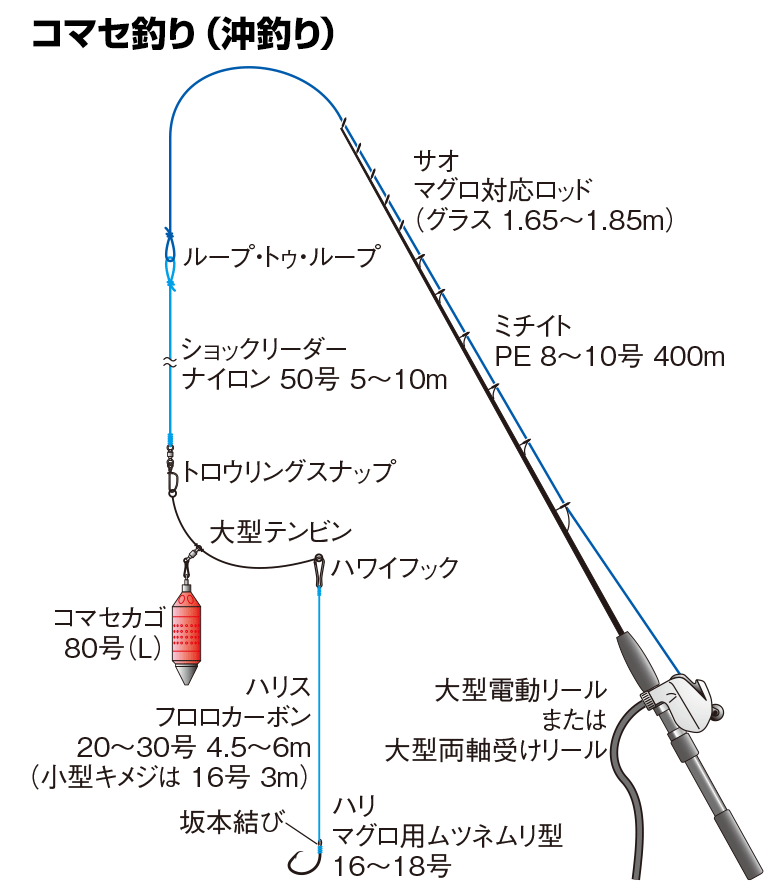
Visual credits and explanatory scope
V-01 · Actual yellowfin-school photograph: NOAA OAR / National Undersea Research Program, via Wikimedia Commons. U.S. government-work public-domain status is recorded in the source attribution. This is not a record-catch photograph.
V-02 · Original AI-generated adult identification illustration, not a photograph. Long second-dorsal and anal sickles are size-related; young fish need not carry the same fins.
V-03 · Original ecological illustration of small/young yellowfin in the upper-water floating-object context described by NOAA. The illustration does not establish an exact age, nursery location or dependence on every floating object.
V-04 · Original regional feeding-context illustration informed by the south-of-Martha’s-Vineyard jigging account. The forage is drawn generically, not identified to an exact prey species; this is not a filmed capture or universal diet claim.
V-05A · Original teaching illustration with controlled vector line and terminal overlay. Bow position, separation before lowering and short controlled lifts follow the attributed Sagami Bay field account; the Honda example supplies the separate rig topology. No fixed depth or measured trajectory is depicted.
V-05B · Original controlled-vector illustration of Honda’s disclosed yellowfin EBING system, not a copied publisher figure. Unnamed knots and connector models stay unnamed; PE/mainline and reel-capacity labels retain their separate source values. Not to scale.
V-06 · Actual prepared yellowfin steak with walnut sauce, hard-boiled eggs and mixed greens, Massachusetts, photographed by Daderot on 28 April 2026. Species identity follows the original photographer’s explicit title and description, not visual identification of the fillet. Original unmodified photograph, CC0 1.0; this image does not establish food safety or a regional culinary tradition.
V-05C · Original controlled-vector interpretation of Honda’s Yellowfin Tuna komase rig: continuous mainline/shock-leader load path, curved tenbin, one weighted chum-basket branch and separate fluorocarbon hooklength. Actual Shimano and Motegi terminal photographs support two same-facing natural krill on a single hook, first along the shank and second at the back; hidden puncture details are not asserted. Slot pattern, rod guides and component spacing are schematic, not a product model. Unnamed loop-forming knots, basket hardware and Sakamoto tying turns remain unspecified. Japanese gō sizing is not US /0. Not to scale.
V-05D · Original adult rail-side teaching illustration with controlled equipment/line overlays. Honda supplies the separate rig topology, while Matsumoto’s attributed Sagami Bay account supplies the hand-held low-tip position, skipper’s layer calls, two chum releases in that particular drift, small tip signal, thumb-spool/rod-raise response and progressive recovery after the run. These are local method observations, not universal circle-hook instructions, fixed depths or tracked fish movements. Chum particles and recovery arrow are explanatory symbols; exact terminal detail is in the separately audited physical rig.
V-05E · Original full boat/water teaching scene for a regional Yellowfin Tuna surface-casting approach. Casting clear of feeding fish, working the popper and recovering line are explained together; posture and arrows are schematic. The captain's outfit and current maker's popper terminal are separate source evidence.
V-05F · Original controlled-vector teaching diagram. The captain's braid/FG/fluorocarbon/clinch/BB-swivel5/nose-split7 chain is distinguished from the current maker's Mikros-Pop170 with two inline single7/0 hooks on factory rings5. The smaller130 model is not conflated. Knot turns and exact swivel rating are not invented. Not to scale.
V-05G · Original boat/water teaching illustration of Daiwa's Yellowfin Tuna Miyako electric-jig source case. It shows the station, source-described motor/rod work and recovery without claiming a fixed depth, speed or fish track. The unreported hook junction remains a neutral unknown marker, not a reconstructed tying instruction.
V-05H · Original controlled-vector source-layout diagram retaining the exact Daiwa mother's PE5, nylon30, DG60B-4/G300J and KY250g case with one front source-drawn hook. The current KY is sold hookless; its factory swivel/split ring do not disclose the case's hook junction. Hook model/size, cord, attachment and knot remain unconfirmed. This is not a complete assembly recipe.
V-05I · Original full boat/cutaway teaching illustration based on the ChozaburoMaru Yellowfin Tuna live-sardine account. Gentle release and free feed are followed by the source-described bite response and controlled fight. One nose-mounted spade hook is retained; no krill basket, swivel, float or weight is added. No fixed depth or tracked path is depicted.
V-05J · Original controlled-vector interpretation of the complete target-region source mother: spinning outfit, PE5–6 mainline, direct braid/leader junction, fluorocarbon16gō at1.5–2m, one eyeless Owner Cut Hiramasa13 hook and nose-mounted live sardine. The PE4–6 rod-rating example is distinguished from actual mainline. Exact knot turns and puncture microsurgery are not invented.